
What drives the cost of private label pharmaceutical manufacturing?
“How much will it cost?” is the question behind almost every private label enquiry, and it rarely has a single answer. A contract manufacturer prices each product on its own, because the formulation, the dosage form, the pack and the order size all move the number in different directions. This guide explains what actually drives the price, so you can read a quotation and compare it against another one on fair terms.
Why there is no price list
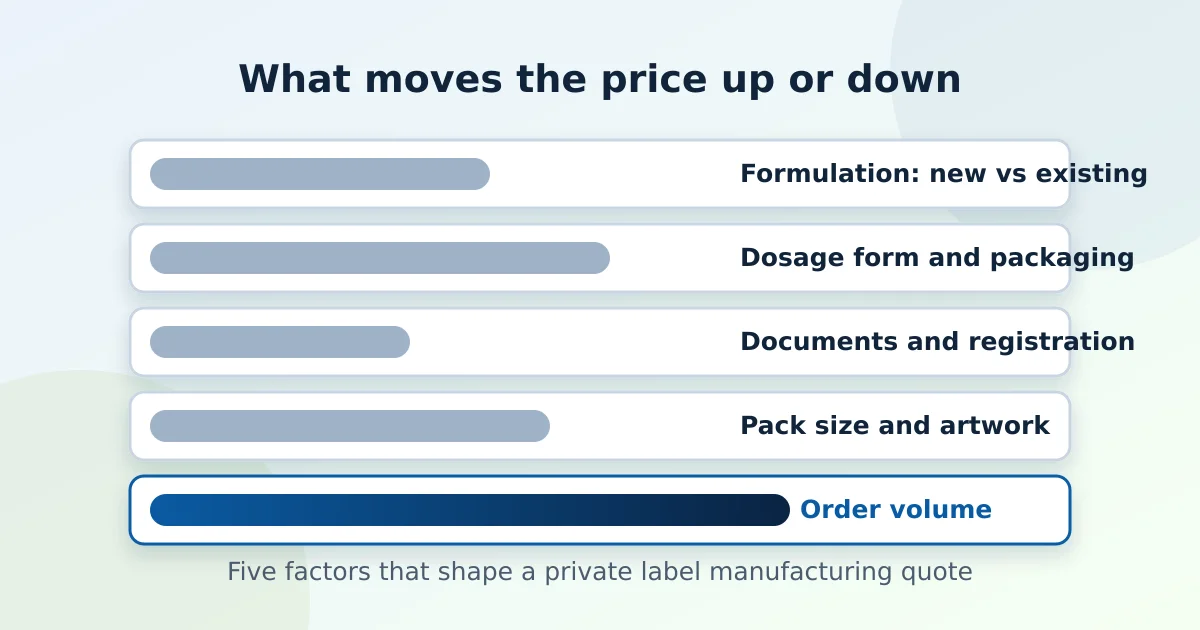
A private label quotation is built from several costs added together, not looked up on a single rate card:
- The formulation itself. An existing product from the manufacturer’s range only needs to be made; a new combination or a copy of a reference product needs to be developed and tested first, which adds a one-time cost spread differently depending on the order size.
- The dosage form. A standard tablet or capsule on a shared production line costs less to run than a sterile injectable, a softgel or a liquid that needs its own line changeover and extra testing.
- The documents your regulator asks for. A Certificate of Analysis is routine for every batch. A full CTD dossier, stability studies or a registration batch made to a specific size add real cost, and that cost usually falls hardest on the first order.
- The pack and the artwork. A pack size and label language the manufacturer already runs costs less to set up than a new carton size, a new blister tool or a label printed in a language used for the first time.
- The order volume. Larger orders spread the fixed costs, such as line setup and artwork approval, over more units, which is why a repeat order is usually priced better than a first one.

Private label vs white label vs custom manufacturing
The branding model you choose changes the cost before any of the factors above come into play. Taking an existing product under white label is usually the lowest-cost route, because the formulation, pack and documents already exist. Private label costs more because more of the pack and label is built for your market. Custom manufacturing, where the formulation itself is new, carries the highest cost, because the batch has to prove the process as well as fill the order.
What tends to raise or lower the quote
| Factor | Tends to raise the quote | Tends to lower it |
|---|---|---|
| Formulation | A new combination or a copied reference product | An existing product already in the manufacturer’s range |
| Dosage form | Sterile injectables, softgels, liquids | Standard tablets and capsules |
| Documents | A full CTD dossier and stability studies for a new market | A market where the manufacturer already holds the documents |
| Pack and artwork | A new carton size or a new label language | A pack size and language already in use |
| Order stage | A first order, carrying setup and registration costs | A repeat order once the product is proven |
Getting a quote you can compare
Because the factors above apply differently to every product, two quotations for “the same” medicine can differ for reasons that have nothing to do with manufacturing quality. Before comparing prices, check that both quotations cover the same strength, pack size, documents and order quantity. Our minimum order quantity guide explains why the quantity alone changes the number. The reliable way to get a quote you can act on is to send a manufacturer your actual product list, with the strength, pack size and country of registration, and ask for the price, the minimum order and the lead time together. Browse our product range or contact us with your list and we will confirm all three.
Questions worth asking before you compare quotes
- Does the price include the documents your regulator requires, or are they quoted separately?
- Is the first order priced differently from a repeat order, and by how much?
- What happens to the price if you choose a pack size or language the manufacturer already runs?
- Does the quotation assume a specific order quantity, and how does the price change above or below it?
- Is tooling or artwork a one-time cost, or is it included in the unit price?
Asking these questions against the same checklist for every manufacturer you compare is a more reliable way to judge value than comparing a single unit price.